THE ART OF SURVIVING ROSH HASHANA THAT FALLS OUT ON SHABBAT
click ki tavo 2026 to download
THE ART OF SURVIVING ROSH HASHANA THAT FALLS OUT ON SHABBAT
On the first day of Rosh Hashanah, you will not hear the shofar. The first day of 5787 falls on Shabbat — Saturday, September 12 — and on Shabbat we don’t blow. The shofar waits until Sunday.
It isn’t that blowing shofar is a melacha, forbidden work. It isn’t. Blowing is not one of the thirty-nine melachot, and the Torah’s mitzvah to blow Shofar applies on Shabbat exactly as it does on Rosh Hashana that falls out on any other day of the week.
The rabbis stopped it. Rabbah explains the decree in Rosh Hashanah 29b: they were afraid a man who didn’t know how to blow would pick up his shofar on Shabbat morning and carry it through the street to someone expert, to learn — and in a place with no eruv, carrying four amot in a public domain violates Shabbat from the Torah itself.
So look at what Chazal did. To guard against a possible violation by one person, they silenced the Mitzvah of blowing Shofar from the Torah on Shabbat, for every Jew alive.
This is a big sacrifice. Blowing Shofar, is what the Gemara says, the only thing that confounds the prosecution. It confuses the Satan. Any year in which the shofar is not sounded at its beginning, says Rabbi Yitzchak in Rosh Hashanah 16b, trouble comes upon it at its end. Because the Satan, the accuser, was not confounded. He was not confused! The Rabbis gave up the one instrument that confuses the Satan in order to protect Shabbat! These Rabbis understood the stakes far better than we do, of what happens when we don’t blow Shofar, and they made that trade. Which means they knew something about what Shabbat can do, that we might have missed.
Rabbi Yaakov Ettlinger of Altona — the Aruch LaNer — wrote in his Torah commentary Minchat Ani, on Parashat Ha’azinu, that he had noticed something about these years that Rosh Hashana falls out on Shabbat. They are never ordinary. The very best years in Jewish history and the very worst ones were years when Rosh Hashanah fell on Shabbat.
Look at the record.
Both Temples were destroyed on Rosh Hashana that fell out on Shabbat.
5253 — October 1, 1492. Spain expelled its Jews; that year they died in the harbors of North Africa and Italy. Eleven days in, on Hoshana Rabba, Columbus made landfall.
5693 — October 1, 1932. Four months later, Hitler became Chancellor of Germany.
5703 — September 12, 1942. The darkest year of the Shoah. And El Alamein. And Stalingrad.
5710 — September 24, 1949. Magic Carpet lifted fifty thousand Yemenite Jews out of exile on the wings of eagles. The Knesset passed the Law of Return.
5713 — September 20, 1952. Stalin announced the Doctors’ Plot and prepared to deport Soviet Jewry. On Purim, he dropped dead.
5736 — September 6, 1975. The UN declared that Zionism is racism, in Cheshvan. Entebbe, in Tammuz.
5750 — September 30, 1989. Five weeks later the Berlin Wall came down. A million Jews walked out of the Soviet Union.
5761 — September 30, 2000. Opened with the Second Intifada. Closed on 9/11.
5781 — September 19, 2020. COVID’s worst year — and the vaccine.
5784 — September 16, 2023. You know what happened three weeks later on Simhat Torah.
But the question stands. Why would these years swing so violently in both directions?
A king condemned two of his subjects to death. Both of their wives worked in the palace. One was the king’s tailor. The other was the king’s cook. The tailor’s wife came before the throne and begged for her husband’s life. The king looked at her. She was well. Cared for. Whole.
He spared him.
Then the cook came and begged for her husband’s life. And the king looked at her — and saw the bruises. The marks on her arms. What had been done to her, week after week, behind a door.
He had her husband executed on the spot. She had come to plead for him. And the evidence against him was standing in the room, wearing her own skin.
The king never asked a single question about either husband. He didn’t have to. He read them off their wives.
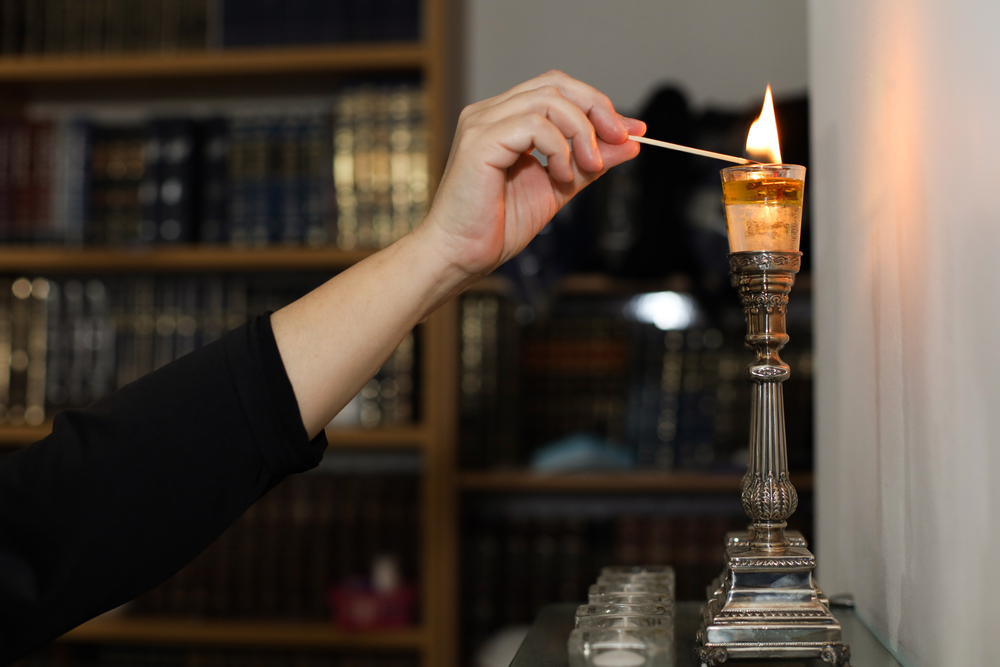
Shabbat is the wife. The Shabbat Queen lives in your house. Fifty-two weeks a year, she comes. And on Rosh Hashanah that falls out on Shabbat, she goes up before the King, to plea on your behalf. On most years the shofar is sounding, the Satan is confused in his accusations, because the Heavenly courtroom is so loud with all the Mitzvoth of the Shofar. But in a year when Rosh Hashana falls out on Shabbat, like this one, the shofar is silent — and there is almost nothing in that Heavenly Courtroom except the Shabbat Queen.
G-d takes a look at the Shabbat Queen.
If she has been honored — candles lit on time, a table set, a day that was actually spiritually and physically different, a man who guarded her when it cost him something — then the King sees a Shabbat Queen woman who has been cherished, and He protects the one who cherished her.
And if the Shabbat Queen has been beaten — treated as a day off, worked around, degraded quietly where nobody could see — G-d notices that on the Shabbat Queen. The marks are the testimony. That is why these years have no middle.
This year and next year, two years in a row, are Rosh Hashana that falls out on Shabbat… All the judgement of Rosh Hashana rests on how the Shabbat Queen walks in to the Heavenly Courtroom. Either she walks in radiant, and the year is one of the great ones. Or she walks in bruised, and Heaven help us. Shamor et yom haShabbat. Guard the Shabbat day. It has always been a two-way word. You guard her — she guards you.
And here is the uncomfortable part. Here is what this asks of you, and it is not what most Rosh Hashanah articles ask. It is not about what you’ll feel in shul. It’s about what has been happening in your house on ordinary Friday nights to the Shabbat Queen when there was no one to impress. Because that is where the marks come from. Not from the dramatic failures — from the quiet ones. You can keep every Halacha in Shulchan Aruch and still make her feel like an obligation. כי יום שמחות הוא ותשמחני. Shabbat is the day of happiness, as it is referred to in the Torah as וביום שמחתכם . No matter what you are dealing with, YOU MUST receive the Shabbat Queen with happiness, and it has been passed down a powerful segula… If you tell G-d, that the worries and fears and stresses of the week, I will put them on hold for Shabbat, G-d will solve all those worries and fears and stresses for you!!
A Shomer Shabbat Jew, can live his whole life, never once being Mechalel Shabbat, desecrating the Shabbat. But he can also, never once, fulfill Kavod Shabbat, respecting Shabbat, like he is supposed to. Kavod Shabbat, is about how you receive the Shabbat Queen, and too many times, although she was not violated, in that hour before candle lighting, before Shabbat, she was met with a house of shouting. That hour, is the most honest hour, of how Shabbat Queen is treated, in your home… Is she received, or is she bruised? Was she someone that you made sure everyone in your home was glad to see? It is not about fixing that hour… It is about fixing how the Shabbat Queen walks in. The phone that never went away till last minute, is a bruise. The meal that everyone ate standing up, is another slap in her face.
None of it felt like I was doing that to the Shabbat Queen. But that’s exactly how it works. Nobody sets out to beat their wife. It happens one small unkindness at a time, and then one day somebody looks at her and can see it. The King is going to look at her in three weeks.
So don’t take on ten things. Take on one, and make it hold. Make one Shabbat that stays. One week where a single thing is different and it doesn’t collapse: the phone goes in a drawer an hour before candle-lighting. Or one meal where nobody leaves the table. Or an afternoon walk with no destination and no purpose.
One thing. Repeatable. Boring by design. Because that’s how a person becomes the kind of husband whose wife walks into the throne room whole. The Shofar alarm won’t sound this year. And the Shabbat Queen will already be standing in the Heavenly Courtroom. This is the year you find out she’s been keeping a record.
Take care of her. She’s the one who speaks for you.
Ketiva v’chatima tova.