The Art of Living Like an Angel
click Vayishlach 2026 to download
The Art of Living Like an Angel
Three times a day we take three steps forward and stand before Hashem. The middle of the Amidah changes all the time. Weekday, Shabbat, Yom Tov, Rosh Hashanah: each has its own. But the first three blessings never change. Not one day of the year.
Why? Because those three blessings are our three fathers. Avraham, Yitzchak and Yaakov.
We open by calling Hashem Elokei Avraham, Elokei Yitzchak, v’Elokei Yaakov, and we ask Him to hear us in their merit. But there’s a problem. The Gemara (Shabbat 55a) already discusses when zechut Avot, the merit of the fathers, ran out. So what are we standing on?
Their merit isn’t a bank account we inherited. It’s a road. If we walk in their ways, their merit walks with us. So before we ask Hashem for anything, we remind ourselves who we come from, and who we’re supposed to become.
The first blessing belongs to Avraham. It ends Magen Avraham, and in it we call Hashem HaKel HaGadol, the great G-d. Great? Hashem has no size. He is infinite. So what does gadol mean? The Torah calls the sun hama’or hagadol, the big light, and the moon hama’or hakatan, the small one (Bereshit 1:16). The sun is the giver. The moon is the taker. Gadol means giver. When we say Hashem is gadol, we’re saying He is the ultimate giver and provider. That is chesed. And Avraham showed the world what that looks like in a human being: chesed l’Avraham (Micha 7:20). How do we know it was really his nature? The Gemara (Bava Metzia 86b) tells us. It was the third day after his brit milah. He was weak and in pain. Most of us, three days after surgery, aren’t even answering the phone. Nobody expected him to host anyone, and Hashem even made the day blazing hot so no travelers would trouble him. And Avraham? He sent Eliezer out to find guests. When Eliezer found none, he went out to look himself. He wasn’t giving because he had to. He gave because he couldn’t not give. Avraham personified Gomel Hasadim Tovim.
The second blessing opens Atah gibor, You are mighty, and ends mechayeh hameitim, who brings the dead back to life. This is Yitzchak’s blessing, and Yitzchak’s midah is gevurah. Not muscle. Inner strength. “Who is strong? One who conquers his inclination” (Avot 4:1). Look at Yitzchak in the Torah. He hardly says a word. What we see, again and again, is his ability to hold. He accepts Hashem’s will at the Akedah. The Pelishtim fight him over well after well, and he moves on and digs again (Bereshit 26). Most of us would still be fighting over the first well. Esav’s wives, with their idol worship, embitter his home (26:35), and he doesn’t throw his son out. Yaakov takes the blessings, and Yitzchak accepts that too: gam baruch yihyeh (27:33). There’s serving Hashem by doing what He commands. And there’s another way: accepting what He wills. That’s Yitzchak.
But why is his blessing about bringing the dead to life? After the Akedah, the Torah says Avraham returned to his young men (22:19). Yitzchak isn’t mentioned. Then, when Rivka arrives, he comes out to the field (24:62-63). The commentaries ask: where was he? He was 37 at the Akedah and 40 at his wedding (25:20). One opinion says he was in Gan Eden. Another says he was in yeshiva, learning Torah. Someone once told me something beautiful. These aren’t two opinions. They’re one. If a yeshiva boy sits in the beit midrash and disconnects from the world while studying, it’s like he’s in Gan Eden.
How does one achieve that experience? The Gemara (Berachot 63b) says Torah stays only with a person who “dies” for it: Zot haTorah, adam ki yamut b’ohel (Bamidbar 19:14). When he’s learning, he’s gone. You can’t reach him. He’s contactless. His phone isn’t on silent. It’s off. He’s “dead” to the world, and more alive than ever. And then, mechayeh hameitim. He comes back into the world to build a home. That’s how our fathers got married. Straight out of a Gan Eden like Yeshiva learning. Yitzchak came to his wedding from his learning. So did Yaakov, after fourteen years in the yeshiva (Megillah 17a).
The third blessing is Atah kadosh, ending HaKel HaKadosh, the holy G-d. This is Yaakov’s blessing. The Navi even calls Hashem Kedosh Yaakov, the Holy One of Yaakov (Yeshayahu 29:23). Yaakov is the father who lived with angels. And he teaches us that a Jewish home and a Jewish life, wherever you are, is holier than the angels.
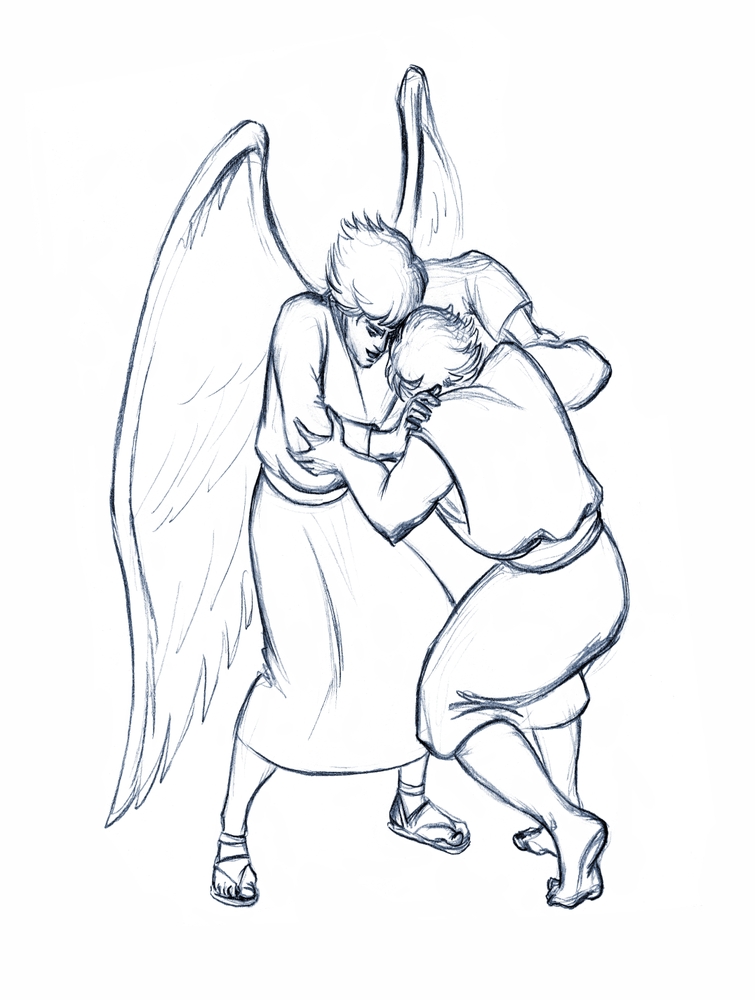
That’s what Kedushah is. Nakdishach v’na’aritzach. We sanctify Hashem with the praise of the angels. And here’s the astonishing part: the angels have to wait for us. The Gemara (Chullin 91b) says the angels don’t say their song above until the Jewish people say theirs below. Ten tired Jews in a shul on an ordinary morning, and all of Heaven is waiting for them to begin. And where does the Gemara teach this? In the middle of the story from this week’s parashah, Vayishlach: Yaakov’s fight with the angel.
Where did that fight happen? At a crossing called Ma’avar Yabok (Bereshit 32:23). Yabok. Yud, bet, kuf. Now look at Kedushah. It always has three parts. Kadosh, kadosh, kadosh (Yeshayahu 6:3). Baruch kevod Hashem mimkomo (Yechezkel 3:12). Yimloch Hashem l’olam (Tehillim 146:10). The first letters of each passuk spell Kuf, bet, yud. The letters of Yabok. Rav Moshe David Valle explains what this means for us. In the hardest test of your life, b’chol derachecha da’ehu, in all your ways know Him (Mishlei 3:6). Connect to Him right there, in whatever you are dealing with in your life journey. That connection, is where the holiness is found. Because we tell ourselves a story. “Me? An angel? You don’t know where I’m holding.” We think that from the low places, we can’t be like angels. It’s not true.
You’re in the middle of an argument. The perfect comeback is sitting on your tongue. It’s a really good one, too. And you hold it back, even a drop. Our Sages teach that for every moment a person holds back from answering, the reward is more than the angels can fathom. The Gemara (Chullin 89a) says the world itself exists in the merit of one who restrains himself in a fight.
You leave a little food on the plate. That is greater than the greatest fast, because you went against the animal inside.
You guard your eyes and your thoughts. That is angelic too.
Three places: what goes into the mouth, what comes out of it, and what the heart desires. That’s why Yaakov was tested in how he responds: to his brother, to his father, to his children.
Still think a human being can’t be angelic? Go back one parashah. When Yaakov wakes from his dream of the ladder, he says: Achen yesh Hashem bamakom hazeh, v’anochi lo yadati (Bereshit 28:16).
Achen is alef, kaf, nun: Aryeh, Keruv, Nesher. The lion, king of the wild animals. The eagle, king of the birds (Chagigah 13b). The keruv, king of the angels. Yaakov looked up and saw three faces on the Heavenly Throne. And the fourth face, the face of a man! That one was his own face! The Gemara (Chullin 91b) says the angels went up the ladder to look at his image above, and came down to look at him below. A human being, asleep on the ground, and his face is under the Kisei HaKavod. King of mankind. Anochi, spells Aryeh, Keruv, Nesher, Yaakov… v’anochi lo yadati “I never knew my face was on the throne as well!”
I always wondered though about the ox, king of the domestic animals. Yechezkel sees the face of an ox on the Throne too (Yechezkel 1:10). The Jewish people saw it at Har Sinai, and that’s where the calf came from. So why didn’t Yaakov see it?
The answer is simple. The ox is Yosef: bechor shoro hadar lo (Devarim 33:17). The face of the ox is there in Yosef’s merit, and that night there was no Yosef yet. This explains why they made a Golden Calf. Moshe was gone (Shemot 32:1) and the people panicked. Who will feed us out here? We only have Mannah in Moshe’s merit! They wanted a Yosef, the provider who fed a whole land (Bereshit 42:6). So they reached for the ox.
So how do we become like Yaakov?
It’s hard. We have a yetzer hara, and the Gemara (Kiddushin 30b) says that without Hashem’s help, no one could overcome it. That’s why the first blessing of Avot ends Melech ozer u’moshia u’magen: King, Helper, Savior, Shield. We’re asking: help me, save me, so I can be like Avraham, Yitzchak and Yaakov.
Yaakov stands for three things that are really one: tiferet, balance and harmony; Torah; and emet, truth (titen emet l’Yaakov, Micha 7:20).
Avraham is kindness. Yitzchak is strength. Two extremes. Yaakov, ish tam yoshev ohalim (Bereshit 25:27), balanced them through his Torah. Tam is from the word Tiomet of the Lulav, which is the middle branch between the two extremes. That’s why he is the highest of the Avot. Balance means finding the deeper truth of what’s right, right now. When to give. When to hold. When to be honest, and when to trick. In our lexicon, middle of two extremes, between high and low, hot and cold, boils down to being normal and acting normal. What, exactly is normal?
Everyone wants to be normal. But normal usually means whatever my crowd does. What they drive, where they vacation, what they serve at a bar mitzvah. The Rambam says a person is naturally pulled after his friends and the people of his town (Hilchot De’ot 6:1). In Judaism there is only one normal: what the Torah calls normal.
In the Syrian community, people ask this all the time. Should we live in Deal? Brooklyn? Manhattan? Lakewood? Miami? The answer is always the same. Live where you can learn the most Torah and live by the Torah the most, and where your children can too. As Rabbi Yosi ben Kisma said, “I will live only in a place of Torah” (Avot 6:9).
That’s what it means to build a home for the Shechina. When Yaakov came back toward Eretz Yisrael, angels met him, and he called the place Machanayim, two camps (Bereshit 32:2-3). The Ramban explains: his camp of his family on earth and the camp of angels above, parallel and in sync. Yaakov realized that everything he’d been through was building a people who live like angels, with Torah even in the most earthly parts of life.
There is one more secret, and it’s hiding in that same pasuk.
Vayikatz Yaakov mishnato vayomer: Yaakov woke from his sleep and said. The Baal HaTurim points out that the last letters of those four words spell tzibur, a congregation.
Kedushah can only be said with ten (Megillah 23b), because when ten Jews pray together, the Shechina is with them (Berachot 6a). And the Gemara (Ta’anit 8a) teaches that when a person prays alone without kavanah, his prayer isn’t always accepted. The prayer of a tzibur is accepted even without kavanah. In the Rambam’s words, “the prayer of the congregation is always heard” (Hilchot Tefillah 8:1).
Now read the pasuk again. Achen yesh Hashem bamakom hazeh: Hashem is surely in this place, when there’s a tzibur, a minyan. V’anochi: but when it’s just me, by myself? Lo yadati. I don’t know.
You want to live like an angel? Don’t try to do it alone.
There’s a reason we’re called Bnei Yisrael. Yisrael is the name Yaakov earned the night he fought an angel and won: ki sarita im Elokim v’im anashim vatuchal (Bereshit 32:29). Our job is to live angelic lives down here, with a body, a family, a minyan, a job and a carpool.
So the next time you take three steps forward, remember what those three blessings ask of you.
Give like Avraham, because it’s who you are.
Hold like Yitzchak, even when everything in you wants to answer back.
And live like Yaakov: a life of Torah and truth, with a minyan around you, in a home where the Shechina is welcome and a home where the Torah defines what’s normal.
It’s hard. Nobody can do it alone. That’s why we say it three times a day: Melech ozer u’moshia u’magen.