THE ART OF BEING BSIMCHA
click terumah 2026 to download
THE ART OF BEING BSIMCHA
There’s a saying from Sweden: those who choose to sing will always find a song. Those who choose to be happy, will always find what to be happy about. Allow me to explain this, because nobody wakes up in the morning and says, You know what, today I’m going to aim for misery. Everyone wants to be happy, but when life is complicated, hard, or painful, not everyone is able to figure out, how to find what to be happy about.
Mishenichnas Adar marbin b’simcha, when Adar enters, halacha dictates that we are to increase in joy. Increase. As in, do more of it. Joy is not merely a mood that appears when life is easy. It’s something active. Something you can grow. So what exactly is simcha? Simcha is not a smile. It’s not a burst of emotion. It’s not something you wait around hoping to feel. Simcha is WILLINGNESS. How so?
Imagine a parent woken at three in the morning by a crying child. They get up. Not dancing, not thrilled, not glowing with excitement, just tired. But inside there is no resentment. No inner resistance. Because they love this child. Because they chose this life. Because they want to be there. In Israel, the word we use to describe this state of mind is, B’simcha. When someone asks you for something, and you want to say, I will do it willingly, you say, I will do it, Bsimcha. That inner “yes”, that wholeness with the situation, is simcha.
You can be exhausted and still be b’simcha. You can be overwhelmed and still be b’simcha. Because simcha isn’t about how energized you feel. It’s about whether your heart is aligned with where you are. And you know what? It goes further than that. Sometimes the will is there, but the body isn’t cooperating. You want to show up, but you’re drained, distracted, cold, tense, or discouraged. So what do you do? You remove the obstacle. You make coffee so you can stay awake. You put on a sweater so you can stay warm. You take a walk to clear your head. You turn on music to shift the atmosphere. These are not indulgences. They are tools to help you do what you want to do, willingly. You want to live with purpose, but you’re stuck in stress, pressure, confusion, or fatigue. Simcha doesn’t only mean doing something willingly. It means doing whatever is necessary to create the conditions that allow your willingness to function.
Simcha is not a feeling that arrives when everything is perfect. Simcha is the decision to be whole with where you are, and it includes all the efforts you need to make that wholeness possible. When we are to serve G-d Bsimcha, with happiness, it is more about the willingness to serve, than a smile pasted on the face. Simcha, willingness, is difficult. We drag our feet too often in life, saying, Ok, Ok, Ok, I’ll do it, and just get over with it, just stop bothering me…
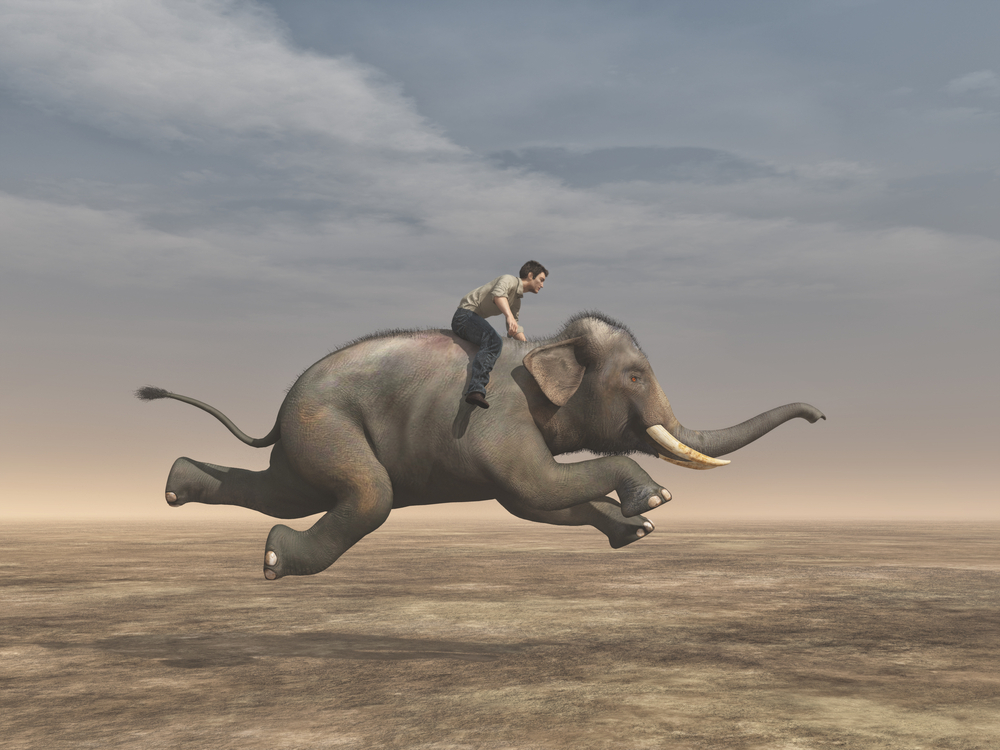
Why is it hard to live life fully, with willingness? Because inside every person there is tension. Ancient wisdom described it as the struggle between BODY and SOUL, a war going on inside every single person.אוי לי מיצרי אוי לי מיוצרי Modern psychology uses a similar image: a rider on an elephant. The rider is the rational mind, making plans and setting direction. The elephant is the emotional, instinctive system… powerful, sensitive, and not always interested in the rider’s agenda. If the elephant decides to move, the rider is coming along whether he likes it or not. When there is an addiction, or when there is trauma, the elephant is not listening to the rider.
The reason why people who choose happiness are still not happy, and still not able to take on life willingly, is because they don’t understand that there are these two brains inside them. There is the brain of the rider, the Neshama. And there is the brain of the elephant, the Nefesh (Guf). Choosing happiness means, choosing to see the way of the Neshama, of the rider, and not of the elephant. The brain of the rider, is calm, optimistic, living for purpose, meaning and truth, and focused on what is IMPORTANT. The brain of the Elephant is animalistic, hard wired for survival and survival of the specie, fight or flight reactive, constantly scanning for problems, wired to detect danger. It amplifies negative information because, from a survival standpoint, threats matter more than comforts. It insists, that all that it is worried about, passionate about, scared about, is URGENT.
When life is tough, when you feel like it is hard to be happy, and you are losing willingness to do the things that are important in life, it is because with all the difficulties you’re going through, your elephant brain is on high alert, and one worry can overshadow ten blessings. Why? Because the inner voice of Elephant brain is LOUDER than the inner voice of the brain of the rider, and this is because the Neshama rider’s voice is quiet and soft. It does not shout. It requires you to meditate, to be calm, to hear it. Just like criticism hits you harder than praise, so too, the voice of the Elephant hits you harder than the voice of the Rider.
This is also why good things fade into the background, but difficult things take over your life. A person can receive enormous blessings, success, relationships, stability, even win the lottery, and still feel dissatisfied months later. This is because the Elephant mind has already moved on, searching for the next problem to solve. As long as you are in problem solving mode, you are still in your Elephant mind, and you become an expert at noticing what’s missing, and what problems need to be solved, but amateur at noticing what’s present, what’s good, and what prayers G-d already answered.
To explain this concept of happiness, and Elephant psychology, we can focus just a second on the Segulah from R’ Shtern, Mashgiach of Kamenitz. A man comes home from work, sits down, and starts complaining. Everything is wrong. Life is hard. Nothing is working. What should the wife do, with her complaining husband?
She should listen, not argue, not try to reason with him or fix his thinking. And then, she should quietly get up and set the table. Then the magic happens. The husband sees the food, something in him settles. The elephant calms down. The noise in his head gets quieter. And now, suddenly, she can have a conversation where she can reach him and talk him through it. Why? Because when the Elephant sees food, the Elephant becomes calm, and she can talk to the Rider again. When you address the body, when you calm the Elephant, you can communicate with the Rider.
So what does it mean to choose happiness? It means to choose the voice of the Rider over the voice of the Elephant. How does one do that, when the Elephant is so LOUD and the Rider is so quiet?
In this week’s Parasha, we learn that Moshe used the skin of an animal called Tachash, to cover the Mishkan. That Tachash was a unique creature that existed briefly just for this sacred purpose. It was stunning, covered in extraordinary colors, dazzling in its appearance. It was so dazzling, that its name was translated in Targum as sasgona, “one who rejoices in its colors.” Sas means to be joyful, as we say about the Brit Milah, שש אנכי על אמרתך, and Gavna means colors.
The Talmud tells us, that with all its beauty, it also had a single flaw: it had an ugly horn on its forehead that disrupted its beauty. Think about that. Hashem creates this magnificent creature, gives it every color imaginable, and then puts a horn right in the center of its face that ruins the whole picture. Why? And more importantly, the tachash REJOICED. It celebrated its colors. It didn’t stare at the horn. It lived in full awareness of its beauty, carried its flaw with dignity, and went on to become part of something holy, the main beauty of the Mishkan in its entirety! G-d had many animal skins to choose from, but G-d specifically choose the beautiful Tachash, because it was happy with its colors, even though it had a horn right in the middle of its face!
What do most of us do in life? Because of our Elephant brain, we zoom all the way in on the one thing that’s wrong, and blur out the hundred things that are right. We have health, family, religion, truth, abilities, relationships, opportunities, moments of meaning, a life of how kings lived, clothing, and as Temu put it, we shop like billionaires. But because of the Elephant brain, we spend 90% of our mental energy zooming in on the one thing that’s wrong, the unresolved problem, the unmet expectation, the area of pain, and blur out everything else.
Simcha means choosing a different lens. Not denying the horn. Not pretending life is flawless. But refusing to let the horn on your forehead erase your beautiful colors. Simcha, and life full of willingness, is the decision to be whole with where you are, not because everything is perfect or wonderful, but because this is the life that G-d gave me, the life that G-d willed, so I am willing to live it to the fullest. Joy begins when you stop waiting for life to be without problems, or waiting for life to become easy. Joy begins when you start living life fully, just the way life is.
G-d, wherever You put me, I’ll make sure there’s a good vibe here. I’ll play some music to cheer me up. I’ll put on a sweater when it’s too cold. Drink coffee when I am too tired. If you want me HERE, G-d, Your Will is my will! I will live it fully. Alive. Present. B’Simcha!